
Cinthya Santos-Briones: Living in Sanctuary
February 6, 2027 to March 20, 2027
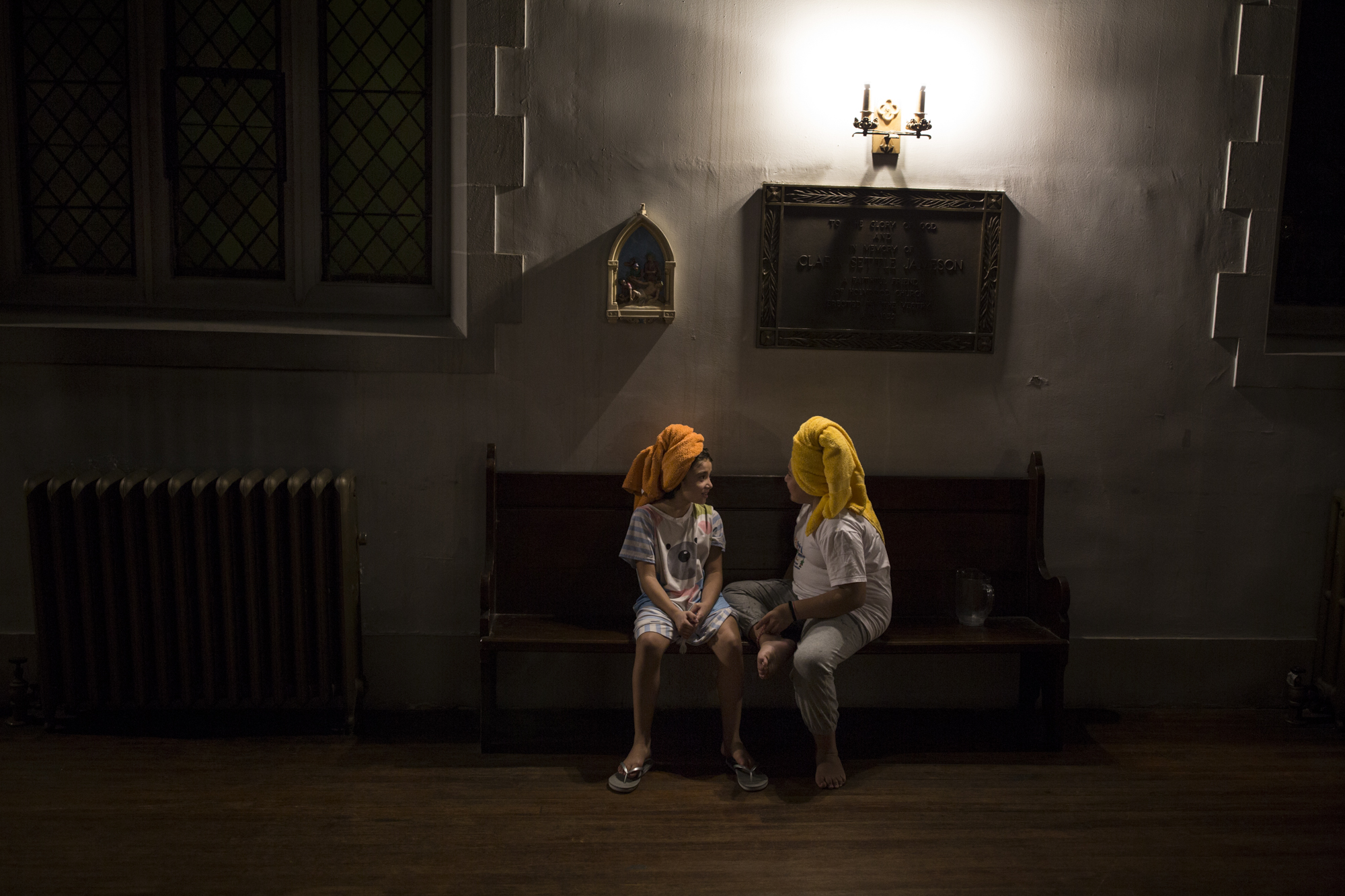
During the first administration of Donald Trump, mass deportations and family separations became defining features of U.S. immigration policy. In response, undocumented migrants across the country turned to churches, temples, and faith communities as spaces of protection and resistance. Within these spaces, sanctuary ceased to be merely a place; it became a collective practice—an assertion of presence in the face of expulsion.
Among pews, stained glass, and altars, daily life unfolded under conditions of prolonged uncertainty. Families from Iraq, Indonesia, and Guatemala assumed visible roles of leadership, making their cases public and transforming vulnerability into a form of political agency. To live in sanctuary meant inhabiting a suspended time: days marked by the threat of surveillance and deportation, but also by ordinary acts—cooking, prayer, celebration—that insisted on life as a form of resistance.
Supported by networks of congregations, clergy, and organizers, these spaces redefined the meaning of community under conditions of criminalization. Sanctuary operated not only as refuge, but as a form of civil disobedience in which faith and politics converged. Hospitality became a daily practice of justice.
Today, under renewed efforts to erode sanctuary protections, many migrant families remain subject to surveillance, detention, separation, and deportation. In this shifting landscape, faith-based movements persist—often less visibly—through acts of accompaniment, protection, and care that sustain communities under threat.
Living in Sanctuary is an ongoing project developed since 2017. Bringing together photographs, testimonies, drawings by migrant children, collages, and archival materials from the Sanctuary Movement of the 1980s, the work traces how migrant, refugee, and asylum-seeking families reconfigure the boundaries of home and belonging while living under constant precarity.
The project emerges from a situated and collaborative practice, shaped through long-term accompaniment within sanctuary communities and participation in faith-based organizing and legal advocacy. Rather than speaking for its subjects, the work constructs an intimate archive grounded in listening, proximity, and shared experience.
Rooted in longer histories of resistance, the sanctuary movement draws from liberation theologies that traverse time and geography: a manger in Bethlehem, the clandestine routes of the Underground Railroad, the chapel of Óscar Romero in San Salvador. These spiritual and political genealogies continue to inform contemporary practices of refuge.
At the intersection of faith and politics, Living in Sanctuary reframes sanctuary as a space of collective resistance and asks what it means to practice hospitality, justice, and belonging in a time when these very acts are increasingly criminalized.
Living in Sanctuary by New York City-based artist Cinthya Santos-Briones is an ongoing project developed since 2017. Bringing together photographs, testimonies, drawings by migrant children, collages, and archival materials from the Sanctuary Movement of the 1980s, the work traces how migrant, refugee, and asylum-seeking families reconfigure the boundaries of home and belonging while living under constant precarity.
EXHIBITION SPONSORS: Diana F. Cramer, Michael DeSalvo & Nick Orth, Margrit Diehl, Deb the Painter, Julie Gozan & Tom Keck, John P. Haritatos, Thomas Mueller, Deirdre Neilen, Kate O’Connell, Arthur & Viola Paris, Katherine & Craig Polhamus, Sharon Sullivan and Carmen Viviano-Crafts, and Ann Tiffany & Ed Kinane.
SEASON SPONSORS: Wendy Bousfield, Joseph Carpenter & Richard Odom, Cheryl Chappell: Edgewood Gallery, Annemarie Deegan, Therese A. Deegan, Terry Eckert, Christine Flynn, Gegensatz Press, Richard Jaeger, Ann Jamison, Jeremy McKay, Lauren & Walter Melnikow, Diane Murphy, Shirley & Larry Novak, Roberta Savage, Ellen Schwartz, Sharye Skinner, Dave Thomas: In Memory of Mary Kuhn, Ron Van Norstrand, Vince Sgambati: In Memory of Jack Stevens, Rose Viviano: In Memory of Charlie Crafts, Deborah Welsh & Bob Gates, Shaila Wood & Ramesh Gaonkar, Wendy Yost, and Amy Zamkoff: In Memory of Sydney Maines
SPECIAL BENEFACTORS: Anonymous (2), Donald Blair & Nancy Dock, Karin Franklin-King: In Honor of Mary Kuhn, Claudia Gebhardt, Samuel D. Gruber in memory of Judith E. Meighan, Diane LaFrance, Nancy & Bruce McCoy, Rick Olanoff & Susan Wadley, Dorothy and Marshall Reisman Foundation, Laura Reeder & Bill Bullen, Robert Sarason & Jane Burkhead, and Pam Voitik
SUSTAINING SPONSORS: Walter Putter & Marilyn Smith